
Before We Gather with Bayo Akomolafe Recap: What If Hope Isn’t the Destination?
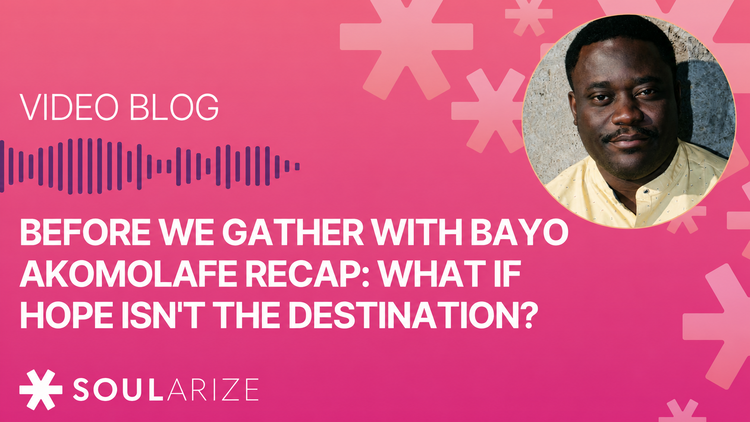
As we continue our Before We Gather series leading up to Soularize 2026, we recently had the privilege of spending an hour with philosopher, poet, and systems thinker Bayo Akomolafe. Like many conversations with Bayo, it wasn’t simply an interview—it was an invitation to see the world differently.
Rather than offering easy answers, Bayo invited us into deeper questions. Questions about hope. About activism. About the stories we inherit. And about what becomes possible when we’re willing to loosen our grip on certainty.
“What if the way we respond to the crisis is part of the crisis?
Early in the conversation, Bayo revisited a question that has shaped much of his work:
What if the way we respond to the crisis is part of the crisis?
It’s a challenging thought. Many of us have been taught that solving the world’s biggest problems simply requires more knowledge, better strategies, or convincing enough people to join the “right side.” But Bayo gently questioned that assumption.
What if our attempts to fix the world are sometimes rooted in the very systems we’re hoping to transform? Rather than abandoning action, he invited us to examine the deeper patterns beneath our actions the assumptions, stories, institutions, histories, relationships, and unseen forces that shape how change actually happens.
We Are Not Separate from the World
One of the recurring themes throughout the conversation was interconnection. Bayo reminded us that we are not detached observers trying to repair a broken world from the outside. We are participants within it.
As he reflected through the wisdom of Chinua Achebe:
“The impatient idealist says, ‘Give me a place to stand, and I shall move the world.’ But there is no place to stand. We are of the earth and we must move at its pace.”
It’s a humbling shift. Instead of asking how we can control outcomes, perhaps the deeper question is:
How is the world already inviting us into something new?
Looking Sideways
One of the most moving moments came as Bayo shared stories about his autistic son, who often looks beside people rather than directly at them. Instead of viewing this as something to correct, Bayo described how his son taught him an entirely different way of seeing. He coined the phrase:
“Looking away at me.”
That subtle distinction became a powerful metaphor. Sometimes truth isn’t found by staring harder at what we already know. Sometimes it appears in the margins. In what we’ve overlooked. In the cracks.
Is Hope Enough?
Perhaps the most surprising part of the conversation centered on hope itself. For many of us, hope is unquestionably a virtue. Yet Bayo challenged us to ask a more nuanced question:
Can hope sometimes keep us attached to the very systems we’re trying to change?
He reflected on one of Martin Luther King Jr.’s final observations before his assassination:
“Why do I feel we’re integrating into a burning house?”
Even after remarkable progress in the Civil Rights Movement, Dr. King recognized that inclusion alone wasn’t enough if the larger system itself remained destructive. Hope, Bayo suggested, becomes limiting when it simply restores what already exists. Instead, he invited us to notice the unexpected openings the cracks where something genuinely new might emerge.
A Conversation That Continues
As the conversation came to a close, participants reflected on what had stirred within them. Some spoke about learning to embrace uncertainty. Others shared how they are discovering greater capacity through rest, celebration, and slowing down rather than constant striving. Still others wrestled with the idea that what feels like dissolving may actually be the beginning of transformation.
No one left with a simple formula. But many left with deeper questions. And perhaps that’s exactly the point.
Join Us at Soularize
This conversation is only the beginning. At Soularize 2026, Bayo Akomolafe will guide our second day as we explore what it means to Find Hope not as easy optimism, but as a courageous willingness to encounter uncertainty, complexity, and possibility together.
If this conversation resonated with you, we invite you to continue the journey with us in Chicago this October. Because sometimes the most transformative gatherings aren’t about finding answers. They’re about discovering better questions.